

Recently, Kirkland & Ellis said it’ll stop voluntarily sharing its revenue and profit numbers with the legal press. This is the firm that crossed $10 billion in revenue last year, with average profits per equity partner of around $11 million. Its reasoning was that the numbers don’t give clients much real value, and that rankings can push firms to chase metrics over quality.

Around the same time AT&T’s legal department announced it’s working with OpenAI to build AI-enabled legal workflows. It’s running through LegalEdge, an AI-first group AT&T set up inside its legal department in January. Lawyers there handle substantive matters using AI tools, with human review built in.
These two developments are more related than we might think. One is one of the most profitable law firms in the world stepping back from the metric that vaulted it to the top of the rankings. The other is one of the most storied companies in the country building legal AI capability with its own team. Together they say something about how to signal quality in legal services, and where the next best proxy for quality appears to be heading.
My guess: the signal is increasingly moving closer to the substantive legal work. I can’t say exactly what it’ll look like—and I’m not sure anyone can yet. I’ve witnessed this from multiple vantage points over the years: as a lawyer, then selling to lawyers for more than a decade, and now as someone who’s operating a legal services business (though most lawyers I know still think of me as the TikTok guy).
Pedigree & Economic Signals
It’s hard to disagree with the content of Kirkland’s letter. We all agree that quality and outcomes should matter most. However, it’s incredibly difficult to assess both from the outside. Much of legal work, even at the highest levels, is about avoiding liability or a major lawsuit. Other times the work is highly confidential.
That’s why the market has long relied on proxies for quality, as opposed to direct measures.1 Pedigree and profits emerged as the next best measures. The schools the firm recruited from sent a message about the caliber of its attorneys, and profits per (equity) partner told you clients were willing to pay huge amounts of money for the firm’s services.
Those signals aren’t just for clients. They’re for recruiting talent too. And they worked on me! Back in 2008, I was going through OCI and I remember choosing my firm loosely based on prestige (and glancing quickly at profits per partner, as if I was ever going to see a dollar of it). Those proxies were useful to exhibit pricing power and to maintain the flywheel effect of drawing the “best” lawyers to the firm (a group I was very much hoping to sneak into), which allowed the firm to charge more for them.
Years later I witnessed the same reliance on proxies for quality from a different angle. At the time I was at a legal AI startup, selling our product to sophisticated legal departments. A pilot with a big company produced results that were hard to measure, and it was difficult to assess what the true business impact would be. True side-by-side tests were incredibly rare.2
As a result, we adapted and pushed our credentials. We talked a lot about our founding team coming out of Harvard Law and MIT (I was not part of that founding team, a detail I conveniently omitted), because the harder it was to see actual results, the more effective those proxies were.
The New AI Signal
For the past few years, showing that you were AI forward grew increasingly important—but it was cheap to signal. License a well-known platform, announce a firmwide rollout, maybe invest in a startup or pick up an innovation award. All of that tells the market you take AI seriously. However, once every firm has done it, it stops being a differentiator.
What’s emerged in its place is building your own AI on top of the frontier models. Some examples:
Kirkland & Ellis committed $500 million over three to four years to build its own AI platform, with around 250 of its lawyers, including about 100 partners, helping design it. It’s funded out of revenue, which means less profit for partners in the near term.
Sullivan & Cromwell built a contract analysis tool working directly with OpenAI’s engineers. The partner who led the project described sitting at his desk typing what he wanted into OpenAI’s coding tool. Not the image most people have of S&C—myself included, which I shared on LinkedIn.
Ropes & Gray built a proprietary diligence tool with OpenAI, designed to produce issue-level diligence reports in hours instead of several days. It follows the same steps the firm’s lawyers use when working through a data room.
Cooley launched GO Public, a proprietary IPO preparation tool built by its capital markets lawyers and legal engineers as a design partner to OpenAI.
Fried Frank rolled out an internally built AI platform for its private equity funds practice, including a multi-agent drafting effort called FundAssist. The firm says it may eventually give clients direct access to the drafting tool.
In April, Freshfields signed a multi-year deal with Anthropic to co-build legal AI workflows and deploy Claude across all 33 of its offices, with early access to future models. Claude runs through the firm’s own proprietary AI platform, where usage jumped roughly 500% in the first six weeks.
Latham took a different role, working with OpenAI on information permissions, ethical walls, client instructions, and firm oversight for OpenAI’s legal offering. Separately, Latham has spent the past three years buying its own Nvidia servers to fine-tune AI models in a data center only its employees can access.
Look, I know what this list makes it look like. If everyone’s doing it, then it’s not really a differentiator. In fact, I made this very joke when Morgan & Morgan announced that it was spending a billion dollars to build its own AI too.

But on the real—actually going through with dedicating resources to building your own AI at the expense of profits is extremely difficult. There are 200 firms in the Amlaw 200, and many more that are considered “Biglaw.” Most of these firms won’t be building their own capabilities any time soon. Because it’s expensive and hard.
Which is exactly what makes building your own AI a credible signal.
AI signaling also happens to be closer to the substantive work than PPEP is. When Kirkland builds proprietary AI around how its own lawyers actually practice, the signal becomes less about profits and more about how the firm plans to exercise judgment at scale.
There are second-order effects too. Building your own AI creates demand for judgment, because someone who has legal expertise & experience has to validate what these systems produce.3 I’ve seen an uptick in demand for these types of roles at Biglaw firms in my day job.
The Client Builds Too
Which brings me back to AT&T. I got a firsthand look when my colleague Jay Harrington and I interviewed Bill Ryan, SVP and Chief Compliance Officer at AT&T, who leads LegalEdge, for Latitude’s podcast. Bill described the origin story of LegalEdge: rolling AI tools out broadly across the legal department wasn’t delivering gains as quickly as they’d hoped.
So a little over a year ago, AT&T decided to build a contained, AI-native team (what he called their “in-house law firm”) to speed things up and serve as a catalyst for the rest of the department.
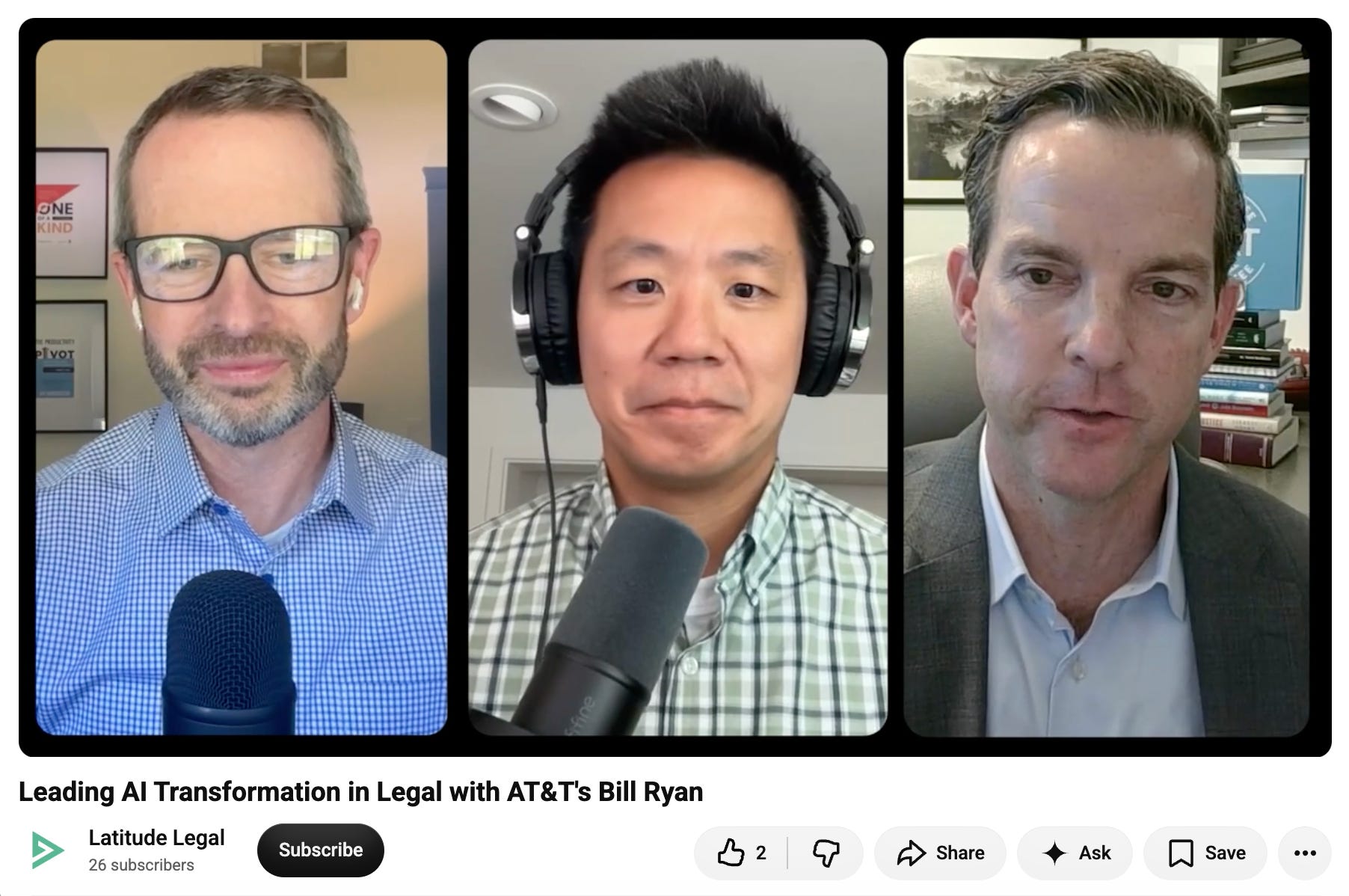
Today LegalEdge takes on a wide range of substantive work, with AI doing more of the work and lawyers reviewing it. AT&T describes it as a way to deliver high-quality legal services at scale using generative AI, and says the new OpenAI work is about making its legal team’s expertise more accessible across the company.
When firms build their own AI, part of the point is the message it sends to clients. When their clients (legal departments) build their own AI, it’s more about capability than signaling.
AT&T isn’t alone in leaning into AI.
Coinbase is too, although in a slightly different way. Its new general counsel, Molly Abraham, has said she wants an engineer embedded in her legal team, since she doesn’t think lawyers are well equipped to evaluate technical solutions on their own. Anthropic’s in-house legal team is designing workflows (in partnership with Freshfields, as mentioned in the previous section) that will deliver Anthropic’s own legal work.
To me, all this suggests how AI signaling will evolve. When the client builds its own AI too, it knows firsthand what that takes.
Where Credentials Belong
Early in my legal tech career, I remember my sales manager directing me to open every conversation by saying I was an attorney. So I did, on every single call, like flashing a badge nobody asked to see. Not only was it ineffective in building trust, it was super cringey. It felt like I was manufacturing a connection based on my credentials, and it always landed flat.
Later I took a modified approach that ended up being highly effective. I started out my calls being extremely concise, technical, and fluid based on what the buyer seemed to want. I demonstrated my competence—and only at the end, after I’d proven myself, did I talk about my credentials.
This experience gave me a preview of where I think signaling is headed. What worked for me was leading with value to the buyer, then high technical competence—and only at the end bringing up proxies for quality. This helps illustrate a coherent narrative that instills a lot of confidence among clients.
I’m not saying credentials won’t matter in our new AI enabled world. In fact they might matter even more. But how they get deployed is an interesting question. Kirkland’s name will sit on resumes long after its numbers stop showing up in The American Lawyer. What I’m less sure about is where that name will fit in the sequence: before the work, alongside it, or after it.
I don’t know exactly how long this AI signal will last. It could be a long time. Or it could go away as every firm races to leverage the same signals as everyone else. Whatever the next signal is, I believe it’ll be closer to the work than any previous signal. That’s good news for buyers. What’s less obvious is what it means for the firms that spent decades building the old one.
I’ve written before about the legal profession’s obsession with proxies for success.
Even when buyers tried to look at results, it was incredibly difficult. I once ran a true side-by-side pilot, where Evisort reviewed a set of contracts and we compared its output against human reviewers. It was really hard to execute, because it required acknowledging that human reviewers were fallible. What reviewer would agree to such a test!? The usual path was a product demo, a trial account, and enough stakeholder consensus to move forward.
It may even create future demand for new types of roles that combine multiple skillsets. For example, there’s a lot of noise about job openings for AI-enabled attorney or legal engineering roles. For the time being I’m watching this space carefully. On the one hand, you have many of these roles (especially LE) opening up at legal vendors where it’s really a sales engineer type of job. On the other, you see mainly law firms hiring for this role, but it’s not clear to me whether this is a substantive role or surface-level signaling. The layers of nuance run deep here—but the main point is that second order effects are very real.