

Earlier this week, the Wall Street Journal reported that some law firms are now charging up to $3,400 per hour. Which led me to share my immediate reaction on social media:

Look, it’s a lot of money. And yet clients are all willing to pay it. So I think you’ve got to accept that clients aren’t paying $3,400 an hour for some lawyer to draft a few memos they can generate from some junior lawyer + AI.
They are paying for effective Risk Transfer.
Clients hire these elite firms to transfer regulatory risk, litigation risk, and reputational exposure to an institution whose judgment they trust. In the legal ecosystem, the product isn’t “outcomes” in the way most AI commentators describe it.
Instead, it’s the credible transfer of consequential risk.
A Venture Bet on AI-Native Agencies
Recently I came across this request for startups on Y Combinator’s website. Basically, they are looking to incubate AI-native law firm startups. I thought it was interesting that they grouped law firms with other types of agencies:1
Agencies have always been crazy hard to scale. Low margins, slow manual work, and the only way to grow is to add more people. But AI changes this. Now instead of selling software to customers to help them do the work, you can charge way more by using the software yourself and selling them the finished product at 100x the price.
Think of a design firm that uses AI to produce custom design work for clients upfront, to win the business before the contract is even signed. Or an ad agency that uses AI to create stunning video ads without the time and expense of setting up a physical shoot. Or a law firm that uses AI to write legal docs in minutes, rather than weeks.
That’s why agencies of the future will look more like software companies, with software margins. And they’ll scale far bigger than any agencies that exist in these fragmented markets today.
My friend, and long-time Off The Record reader Matt Wheatley, saw the same thing and wrote a thoughtful post on LinkedIn and shared my article from last week, leading me to leave the following comment:
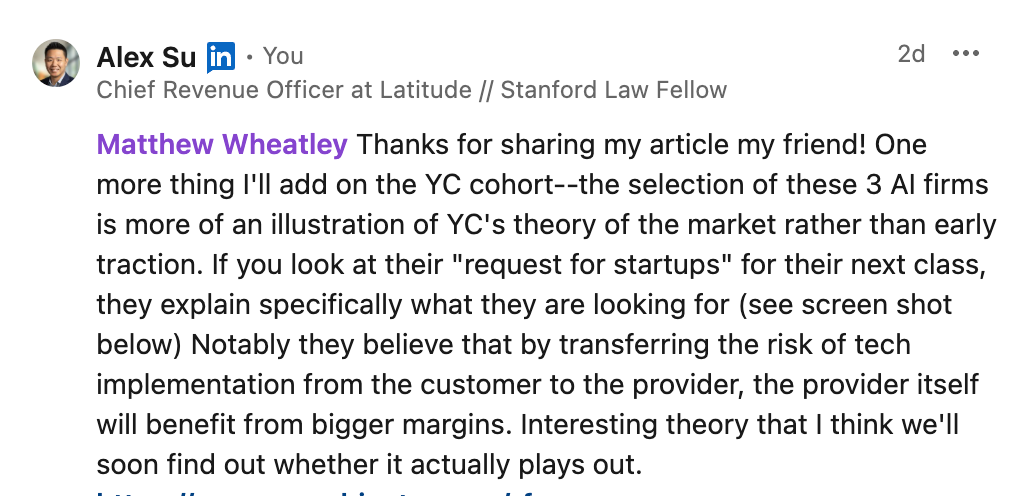
I’m always fascinated by what YC does because it’s usually a leading indicator of what the VC world/tech community is thinking about legal innovation. Here, at its core, this drive towards AI-enabled firms is a margin expansion thesis.2
The thinking goes like this: If AI dramatically increases individual productivity, then smaller, leaner teams can produce more output. Fixed costs compress, leading to expanded gross margins. Implicit to this theory: Distribution becomes the primary lever.
The question is whether this strategy will work in the legal ecosystem. To paraphrase Alex Rampell from Andreesen Horowitz, can these startups figure out distribution (via Risk Transfer) before incumbents figure out how to incorporate AI?
The Legal Industry Works Differently
You won’t be surprised to hear my take here. In marketing, design, or other creative services, outcomes are iterative and downside exposure is limited. Clients can experiment. Efficiency translates quickly into adoption.
Lawyers operate under a completely different structural constraint.
The stakes are asymmetric. Liability is real. A regulatory misstep, an adverse ruling, or a poorly structured transaction can create consequences that far exceed the legal bill itself. When those stakes are present, clients are not simply purchasing work product.
They are purchasing Judgment Under Uncertainty, and the reassurance that the matter has been placed in credible hands.
Productivity has never been the governing variable
Technology has consistently improved execution, from legal research databases to document automation to e-discovery platforms. Yet the firms commanding $3,400 an hour are not simply the most efficient. They are the ones that clients believe can carry risk. Or as my friend Zach Abramowitz put it succinctly:

They are the ones who are trusted.
Building that kind of trust is extraordinarily difficult.
Trust in legal does not come from a glossy brand campaign. It doesn’t come from PR announcements of the latest valuation. It certainly doesn’t come from using tried-and-true go-to-market playbooks that work for selling marketing tech or CRM software.
It is earned slowly, through repeated exposure to high-stakes matters and consistent internal standards.
Just look at how law firms got to where they are today
Organizationally, they look very little like startups. They are deeply de-centralized and are highly partner-driven. Clients often trust specific individuals whose judgment has been validated over the course of decades.
That external trust transfer only works if those partners themselves trust the institution: Its leadership, its standards, its governance. When partners feel aligned and empowered, they extend institutional credibility outward. When internal trust fractures, external trust weakens.
Startups, on the other hand, rely on a command-and-control structure. They organized like the Navy while law firms are organized like a group of pirates.3
Trust requires internal alignment
That dynamic is hard to replicate in a newly formed, unproven institution, like a AI native law firm startup.
Trust compounds slowly. It requires full buy-in from the operating team. It requires autonomy for professionals who themselves feel supported by leadership. Without internal cohesion, it is difficult to convincingly intermediate risk for clients.
This is the messy part that many investor-led models rarely capture.
The open question for AI-native firms is not whether they can deliver high-quality work. Many likely will. In fact, I’ve heard that some are innovating on pricing as well, offering flat fees and volume-based fees (e.g. $X per contract up to 1,000 contracts) I believe these innovations are much needed for the legal ecosystem.
The open (and more) interesting question is whether these AI native firm startups can build the institutional support to deliver external trust at scale. Will they bring on trusted advisors with reputations the startup can borrow? Or will they bring on mercenary GTM operators with minimal accountability to their customer base?

Conclusion
The AI-native agency thesis assumes that legal services can be rebuilt primarily around mechanical optimization and expanded margins.
The historical dynamics of legal markets suggest something more complex: efficiency matters, but it is subordinate to Risk Transfer—which itself depends on deep institutional credibility.
None of this means AI-native firms cannot succeed. They very well may. It just means they are operating in a market where the binding constraint is not feature velocity, but trust velocity.
There, the underlying currency remains institutional credibility. And that currency compounds more slowly than many outsiders might think.
I have worked at 3 different venture backed startups and at each one, executives have fundamentally misunderstood the role law firms play in the ecosystem. Typically they are viewed as a version of a marketing agency or technology implementation services shop. What these execs didn’t realize is that law firms hold a heightened space & status in the minds of senior decision makers in the legal industry. So how you work with them, partner with them, or compete against them will require you to deeply understand how they’re viewed by GCs, CLOs, and other clients.
I’m an outsider to the YC world, but if I were to guess, I’d bet that they are trying to fund startups that could become future platforms for PE backed AI rollups. We have seen other industries consolidate to reduce cost structure, gain economies of scale, and increase margins. For example: General Catalyst has already backed AI-enabled platform consolidation plays in a wide range of industries, including legal. YC has always operated ahead of the curve so them wading into the legal ecosystem signals something they’re seeing more broadly.
Years ago, when I first read that linked 16z article about the navy vs. the pirates, I went down a deep rabbit hole on pirate organizational dynamics and hierarchies. Pirate ships were highly de-centralized and democratic institutions—you could not be a captain unless you earned the trust & buy in of the entire team. That often led to oddly innovative structures and surprisingly liberal values. If you want to learn more I’d highly encourage you to start with this Wikipedia article.
This is brilliant! A spot on piece. Thank you!
This is great. As a bit player in the legal economy I just wrote a Substack piece about how AI is effecting my little practice. Same general conclusion, just from a very different perspective. https://fractionallyyours.substack.com/p/ai-can-do-my-job-i-quit